

By Shamim Sarker | Published: June 11, 2026
✔ Evidence-Based
⚠️ YMYL Health Content
🔥 16 min read
One of the best-selling herbal supplements in America. Decades of anecdotal praise. But what do 27 clinical trials actually show?
Saw palmetto for prostate health has mixed evidence. Large, high-quality studies — including a 2023 Cochrane review of 27 clinical trials involving 4,656 men — found that saw palmetto alone shows little to no benefit for BPH symptoms over placebo. However, some researchers argue that extract quality is a critical variable, and a small number of studies using standardized high-quality extracts do show modest urinary symptom improvements. It is generally safe, low-risk, and may be worth trying for mild symptoms — with your doctor’s guidance.
If you’ve ever Googled “enlarged prostate remedies” at 2 AM after yet another bathroom trip, you’ve almost certainly stumbled across saw palmetto. It’s everywhere — capsules at every pharmacy, glowing reviews online, and decades of anecdotal praise from men who swear it changed their lives.
But here’s the uncomfortable truth most supplement sites won’t tell you: the science is far more complicated than the marketing suggests.
You deserve a straight answer. In this article, you’ll get exactly that — a plain-English breakdown of what the research actually shows, why the evidence is so conflicting, what the “extract quality” debate is really about, and what to do if you’re considering saw palmetto for prostate health. No hype. No spin.
01 — What Is Saw Palmetto?
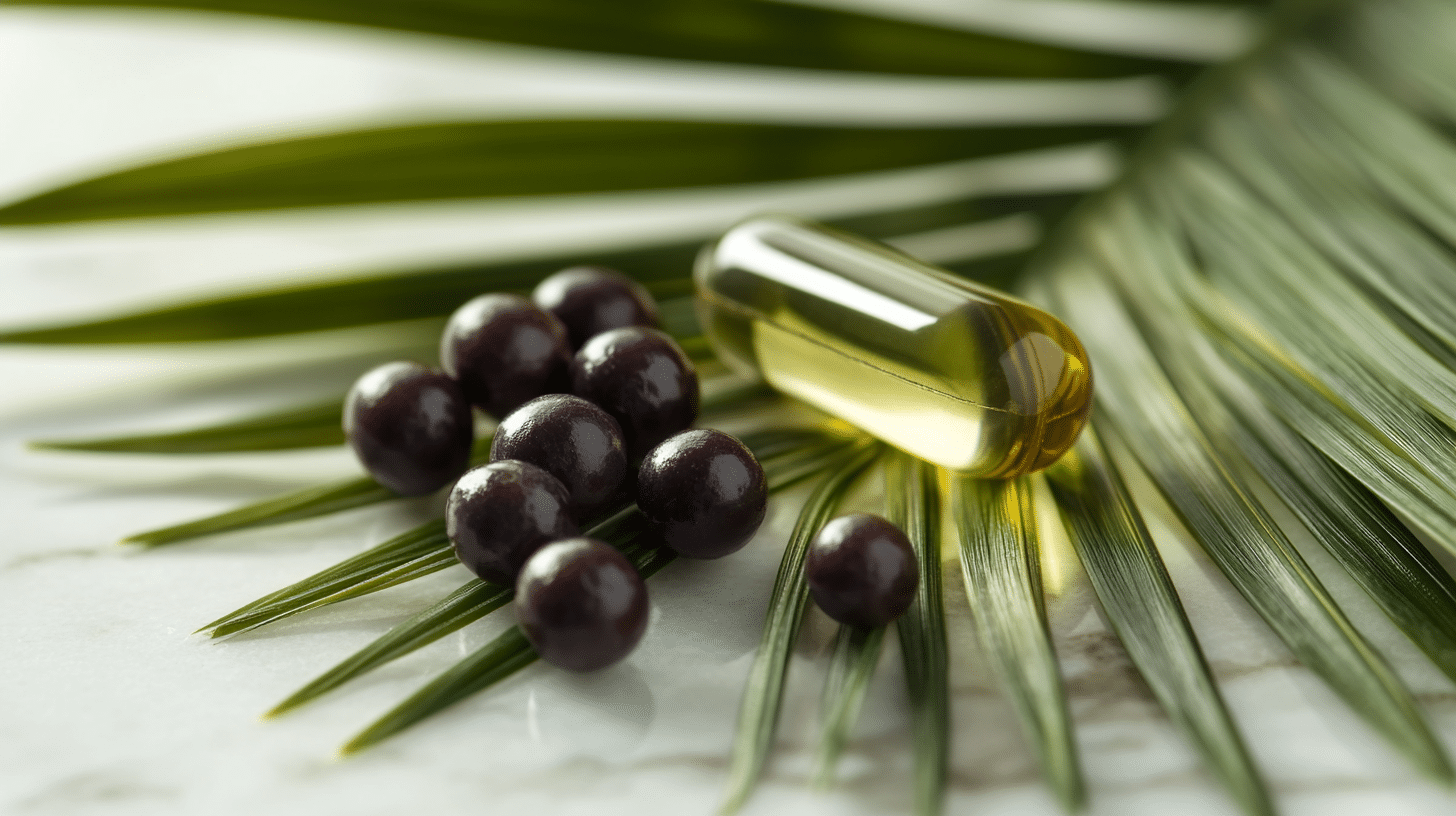
Saw palmetto (Serenoa repens) is a small, slow-growing palm tree native to the southeastern United States. Its dark, olive-sized berries are rich in fatty acids and phytosterols — the basis of one of the most widely sold herbal supplements in the world.
Where It Comes From
The ripe berries are harvested in late summer and processed into oil-based extracts, capsules, softgels, or powders. Native Americans used saw palmetto for urinary and reproductive health for centuries. By the early 1900s, it appeared in the U.S. Pharmacopoeia as a recognized remedy for prostate and urinary complaints (Memorial Sloan Kettering Cancer Center, 2024).
How It’s Sold and Used Today
Today, saw palmetto is among the most widely consumed herbal supplements for prostate health in the United States. In Europe, standardized extracts have held approved status for symptomatic relief of BPH for decades. The most clinically studied dose is 320 mg per day of a standardized lipidosterolic extract — though quality varies enormously between products.
By one estimate, more than a third of all U.S. adults who take dietary supplements use saw palmetto — making it one of the top-five best-selling herbal supplements in the country (Harvard Health, 2025).
02 — What Does Saw Palmetto Do to the Prostate?
The DHT-Blocking Theory
Benign prostatic hyperplasia (BPH) — a non-cancerous enlargement of the prostate — affects the majority of men over 50 and nearly all men over 80. The leading theory behind saw palmetto’s mechanism: it inhibits 5-alpha reductase, the enzyme that converts testosterone into dihydrotestosterone (DHT) — the androgen that drives prostate cell growth.
How the 5-Alpha Reductase Pathway Works
Testosterone → 5-alpha reductase enzyme → DHT (dihydrotestosterone) → prostate cell proliferation. Saw palmetto is theorized to interrupt this conversion — the same mechanism as finasteride, but with much weaker and less consistent clinical evidence.
Anti-Inflammatory Effects
Beyond hormonal effects, saw palmetto extracts also demonstrate anti-inflammatory properties. Some researchers argue this mechanism may be more clinically relevant than DHT-blocking — particularly for men whose symptoms are driven by inflammation rather than physical prostate size (NCCIH, 2024).
03 — What Does the Research Actually Show?
Saw palmetto for prostate health currently shows little to no benefit over placebo in the most rigorous clinical trials, including a 2023 Cochrane review of 27 randomized controlled trials. However, some smaller studies — particularly those using high-quality standardized European extracts at 320 mg/day — have reported modest improvements in urinary flow and nighttime urination. The evidence remains conflicted, and extract quality appears to be a significant variable.
Studies That Showed Benefits
Earlier research — particularly from Europe, where standardized extracts have been in clinical use for decades — was more optimistic. A systematic analysis in American Family Physician reviewed 13 studies and found saw palmetto improved urinary symptom scores and flow measures more than placebo, reducing nocturia by approximately 25% (AAFP, 2003).
Studies That Showed No Effect
A landmark study in the New England Journal of Medicine found no significant difference between saw palmetto and placebo in any outcome measure after one full year of treatment (NEJM, 2006). The follow-up STEP trial, testing escalating doses up to triple the standard amount, again found no benefit.
The 2023 Cochrane Review
The most comprehensive analysis — a 2023 Cochrane review of 27 randomized controlled trials involving 4,656 participants — concluded that saw palmetto provides little or no benefit for BPH symptoms compared to placebo. The NIH’s NCCIH formally states saw palmetto is “probably not helpful” for urinary symptoms (NCCIH, 2024).
The evidence above refers specifically to saw palmetto for BPH. Evidence profiles differ for chronic prostatitis, prostate cancer, and hair loss. This does not constitute medical advice. Always consult a qualified urologist if you have prostate symptoms.
04 — Does Extract Quality Matter?
The active compounds in saw palmetto vary dramatically between manufacturers based on raw material quality, harvest timing, extraction method, and standardization practices. An international panel of urologists concluded that benefit evidence is “specific to a high-quality extract used at 320 mg daily.”
Standardized lipidosterolic extract of Serenoa repens — not “whole berry powder”
320 mg daily dose — the only clinically studied amount
Fatty acid content specified — ideally 85–95% total fatty acids and sterols on label
USP Verified, NSF Certified, or ConsumerLab approved — independent third-party testing
Softgel form — better absorption of fat-soluble active compounds
cGMP-certified manufacturing facility
No proprietary blends — individual doses must be disclosed
Hexane-free or CO₂ extraction — cleaner processing method
05 — Saw Palmetto vs. Other BPH Treatments
| Treatment | Type | Evidence Level | Dose | Key Side Effects | Cost/mo |
|---|---|---|---|---|---|
| Saw Palmetto | Herbal Supplement | Low–Moderate | 320 mg/day | Mild GI upset, rare | $15–30 |
| Finasteride (Rx) | 5-alpha reductase inhibitor | Strong | 5 mg/day | Sexual dysfunction (5–8%) | $30–60 |
| Tamsulosin (Rx) | Alpha-1 blocker | Strong | 0.4 mg/day | Dizziness, retrograde ejaculation | $20–50 |
| Beta-Sitosterol | Plant sterol supplement | Moderate | 60–130 mg/day | Mild, infrequent | $20–40 |
| Lifestyle Changes | Non-pharmacological | Strong (preventive) | N/A | None | Free |
| Pumpkin Seed Extract | Natural supplement | Limited | 320–640 mg/day | Minimal | $15–25 |
Rx = Prescription required. Consult your urologist before starting, stopping, or combining any treatment.
06 — Dosage, Timing & Who Should Avoid It
Always consult your doctor or urologist before starting saw palmetto — especially if you take blood thinners, hormone medications, or have a diagnosed prostate condition.
Recommended Dosage
The only dose with meaningful clinical evidence: 320 mg per day of standardized lipidosterolic extract — taken as one dose or two 160 mg doses with meals. Taking with food improves absorption and reduces stomach upset. Higher doses have not shown greater benefit.
How Long Before You See Results?
Clinical studies that showed any benefit tracked participants for a minimum of 12 weeks. Expect a trial period of at least 6–12 weeks before drawing any conclusions. If there’s no improvement after three months, discuss alternatives with your urologist.
Who Should Avoid Saw Palmetto
- People taking blood thinners (warfarin, aspirin, clopidogrel) — increased bleeding risk
- Anyone scheduled for surgery — discontinue at least 2 weeks before
- People with hormone-sensitive conditions
- Pregnant women — androgenic activity makes it contraindicated
- Anyone on prescription BPH medications — requires physician oversight
07 — Saw Palmetto Side Effects & Safety
Saw palmetto has a well-established safety profile across multiple years of clinical use. Adverse effects are mild and infrequent — mainly digestive symptoms occurring at rates comparable to placebo groups.
One important safety advantage: saw palmetto does not appear to affect PSA levels, even at higher-than-standard doses. Unlike finasteride (which suppresses PSA by up to 50%), saw palmetto will not mask an elevated PSA that could indicate prostate cancer.
Generally well-tolerated for up to 3 years. Mild GI side effects possible. Does not suppress PSA. Minimal known drug interactions. Main precaution: avoid with blood thinners and before surgery. Safe for most healthy adult men at 320 mg/day.
08 — Our Verdict: Should You Try Saw Palmetto?
The Verdict in Plain English
Saw palmetto is not a proven treatment for BPH. The 2023 Cochrane review makes that clear. If you have moderate-to-severe BPH symptoms, prescription medications have significantly stronger evidence.
That said, saw palmetto is not useless. For mild symptoms, a quality-standardized extract at the correct dose is a reasonable, low-risk option — monitored by your doctor. For men considering a more comprehensive formula, our reviews of Prostavive and TitanFlow compare popular multi-ingredient prostate formulas.
Extract quality is the wildcard. Don’t waste money on cheap, unstandardized products.
Standardized lipidosterolic extract
320 mg daily dose on label
Third-party tested (USP/NSF/CL)
Softgel form for better absorption
Full fatty acid content disclosed
cGMP-certified manufacturer
No proprietary blends
Hexane-free or CO₂ extraction
09 — Frequently Asked Questions
10 — The Honest Takeaway
Saw palmetto for prostate health is one of the most studied — and most debated — herbal supplements in men’s medicine. The bulk of high-quality evidence does not support saw palmetto as a reliable treatment for BPH, but it remains a low-risk option for men with mild symptoms — provided they use a quality-standardized product and keep their urologist in the loop.
- The 2023 Cochrane review (27 studies, 4,656 men) found little to no benefit for BPH symptoms over placebo
- Earlier European studies using standardized extracts showed modest urinary improvements
- Extract quality varies enormously — cheap products may explain why many studies fail
- 320 mg/day of a standardized extract is the only evidence-backed dose
- Saw palmetto is generally safe, does not suppress PSA, and has minimal known drug interactions
- It is not a replacement for medical evaluation or prescription treatment for moderate-to-severe BPH
Before starting any new supplement — including saw palmetto — consult a qualified healthcare professional, particularly if you have a diagnosed prostate condition, are taking other medications, or are preparing for surgery.
References
- NIH NCCIH. Saw Palmetto Fact Sheet. NCCIH, 2024.
- Bent S, et al. “Saw palmetto for benign prostatic hyperplasia.” NEJM. 2006. PubMed.
- Tacklind J, et al. “Serenoa repens for BPH.” Cochrane Database. 2023. Cochrane Library.
- Memorial Sloan Kettering Cancer Center. Saw Palmetto — About Herbs. 2024.
- Harvard Health Publishing. Men’s Health — Prostate supplements review. 2025.
- American Family Physician. Saw Palmetto for BPH. AAFP, 2003.
- Mayo Clinic. BPH — Symptoms and causes.
Final Reminder: This article is for educational purposes only. All statements regarding dietary supplements have not been evaluated by the FDA. This article may contain affiliate links — commissions never influence our content or recommendations.
Shamim Sarker is the Founder and Lead Health Reviewer at ShamimGuide.com — an independent platform dedicated to evidence-based supplement and health product reviews. With over 8 years of personal research experience in natural health and wellness, he brings a rigorous, science-first approach to every review published on this site.
His areas of focus include men’s health, weight loss, vitamins & supplements, oral health, and skin care. Every product featured on ShamimGuide is evaluated using a strict 4-step research methodology — ingredient analysis, clinical evidence review, user feedback evaluation, and an unbiased final verdict — so readers can make confident, informed decisions without the confusion.
Disclaimer: Content on ShamimGuide is for informational purposes only and does not constitute medical advice. Some articles contain affiliate links — commissions never influence editorial ratings or recommendations.