
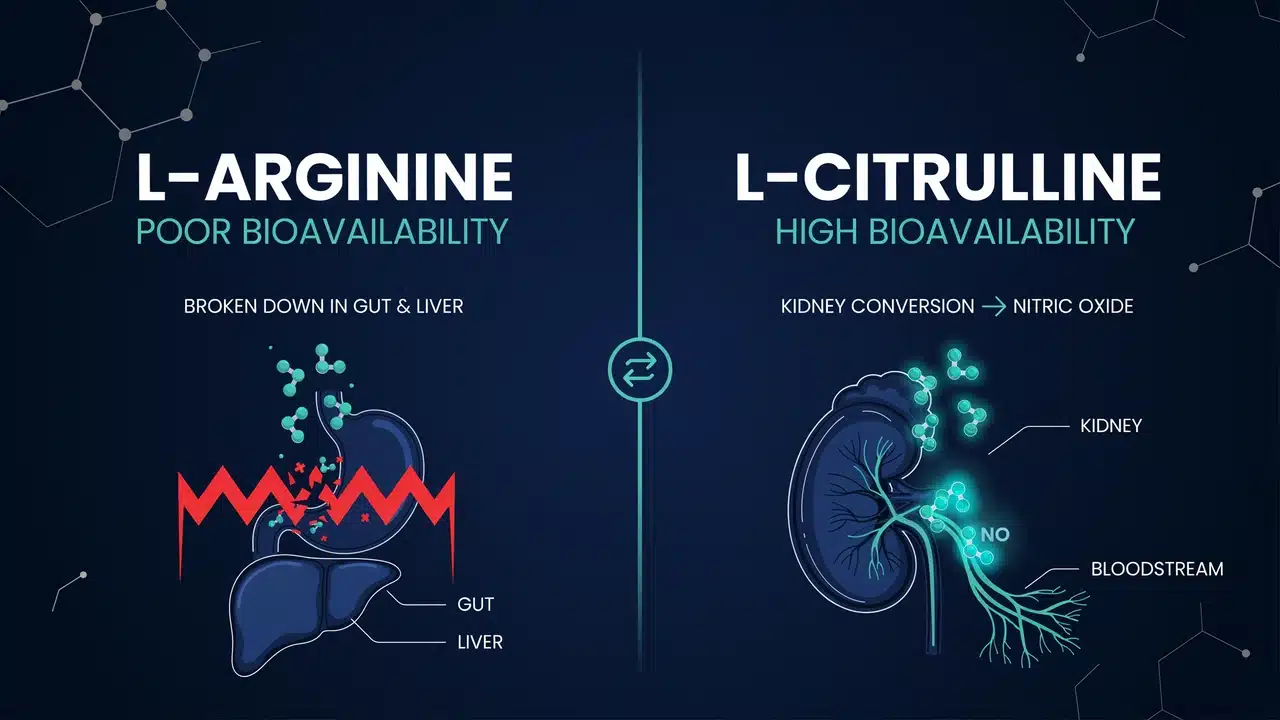

L-Citrulline is the better choice for blood flow support. While L-Arginine is the direct building block for nitric oxide, up to 50% of an oral dose is destroyed in the gut and liver before reaching your bloodstream. L-Citrulline bypasses that breakdown, converts to arginine in the kidneys, and delivers higher, more sustained nitric oxide levels — with significantly fewer digestive side effects. For most men, L-Citrulline is the smarter and more efficient option.
- Up to 40–50% of oral L-Arginine is degraded by gut and liver arginase enzymes before reaching systemic circulation (first-pass metabolism).
- L-Citrulline produces roughly double the plasma arginine levels compared to an equivalent oral dose of L-Arginine (Schwedhelm et al., British Journal of Clinical Pharmacology, 2008).
- Citrulline malate (8g pre-workout) increased resistance training repetitions by 53% and reduced 24-hour muscle soreness by 40% vs. placebo in a 2010 RCT (Perez-Guisado and Jakeman, JSCR).
- Meta-analyses show L-Citrulline supplementation may reduce systolic blood pressure by approximately 4 mmHg with consistent daily use at 6g.
- A 2011 randomized trial found that 1.5g of L-Citrulline daily significantly improved erection hardness scores in men with mild erectile dysfunction (Cormio et al., Urology).
- Combining 2–3g L-Arginine with 6g L-Citrulline covers both the immediate and sustained nitric oxide windows — the most complete stack for maximum output.
You have probably stared at a supplement label wondering: should this be L-Arginine or L-Citrulline? Both promise better pumps, improved circulation, and cardiovascular support. Both work through the same nitric oxide pathway. But here is what most labels will not tell you — one of these amino acids is dramatically more efficient at reaching your bloodstream than the other. In this guide, you will get a clear, science-backed breakdown of L-Arginine vs L-Citrulline: how each one works, what the clinical research actually shows, and exactly which one (or combination) makes the most sense for your specific goals.
What Are L-Arginine and L-Citrulline?
L-Arginine and L-Citrulline are amino acids that both support nitric oxide (NO) production — the molecule your body uses to relax and widen blood vessels. L-Arginine acts as the direct raw material for nitric oxide synthesis, while L-Citrulline works as a precursor that converts into L-Arginine in the kidneys, ultimately raising nitric oxide levels through an indirect but far more efficient route.
What Is L-Arginine?
L-Arginine is a semi-essential amino acid your body produces in limited quantities, with additional amounts coming from protein-rich foods like meat, fish, dairy, and nuts. It is the direct substrate for nitric oxide synthase (NOS) — the enzyme responsible for producing nitric oxide. On paper, that makes it the obvious choice for blood flow support. The catch? When you take L-Arginine orally, your gut wall and liver go to work on it immediately. Enzymes called arginases break down a significant portion before it ever reaches systemic circulation. Studies using isotope-labeled arginine have found that roughly 40–50% of an oral dose is degraded before reaching the bloodstream — a process known as first-pass metabolism. This is the central limitation of oral L-Arginine supplementation.
What Is L-Citrulline?
L-Citrulline is a non-essential amino acid named after Citrullus lanatus — the Latin name for watermelon, where it was first isolated. Your body actually produces L-Citrulline naturally as a byproduct of the nitric oxide synthesis reaction. When you supplement with L-Citrulline, it takes what looks like the long route: absorbed in the small intestine, transported to the kidneys, and converted into L-Arginine there — before entering systemic circulation. That indirect route is what makes all the difference. Unlike arginine, citrulline is not a target for arginase enzymes in the gut or liver, so it passes through largely intact. The result is a higher and more sustained rise in blood arginine levels than you would get from taking arginine directly.
How Do They Work to Improve Blood Flow?
Both amino acids improve blood flow through the same final pathway: more L-Arginine available to nitric oxide synthase produces more nitric oxide, blood vessels relax and widen (vasodilation), and circulation improves throughout the body.
Think of L-Arginine as a direct highway with a heavy toll booth at the entrance — your gut and liver extract a significant tax before you pass through. L-Citrulline is the back road that bypasses those toll booths entirely, taking a slightly longer route through the kidneys but delivering almost everything you put in.
L-Arginine vs L-Citrulline: Head-to-Head Comparison
Choose L-Citrulline if you want reliable blood flow support, better workout pumps, cardiovascular health benefits, or sexual health support with minimal side effects. Choose L-Arginine or a combination stack if you want an immediate short-term nitric oxide boost, are working with a tighter budget, or are already using citrulline and want to maximize effect.
| Feature | L-Citrulline | L-Arginine |
|---|---|---|
| Role in the body | Precursor → converts to arginine in kidneys ✓ | Direct precursor to nitric oxide |
| Bioavailability | High — bypasses gut and liver metabolism ✓ | Low — 40–50% degraded before bloodstream |
| Duration of effect | Sustained (slow-release arginine effect) ✓ | Shorter-lived plasma spike |
| Athletic performance evidence | Strong, consistent clinical evidence ✓ | Mixed results across trials |
| Blood pressure support | Consistent findings in meta-analyses ✓ | More trial data but variable outcomes |
| GI tolerance | Generally very well tolerated ✓ | GI distress common at doses above 9g |
| Erectile function | Studied at 1.5g/day for mild ED ✓ | Also studied; 2.8–5g/day protocols |
| Effective dose | 3–6g daily; 6–8g pre-workout | 3–6g daily |
| Common forms | Pure L-Citrulline; citrulline malate 2:1 | L-Arginine base; HCl; AKG |
| Cost per gram | Slightly higher per gram | Generally lower per gram ✓ |
| Best overall use | Workouts, sustained blood flow, BP, sexual health ✓ | Short-term NO boost; combination stacks |
Which Is Better for Athletic Performance?
For exercise performance, L-Citrulline — specifically in its citrulline malate form — has the stronger and more consistent evidence base of the two.
The performance benefit comes from two mechanisms working together. First, citrulline raises blood arginine, boosting nitric oxide and improving oxygen and nutrient delivery to working muscles. Second, citrulline assists the urea cycle — helping your body clear ammonia, a fatigue-promoting byproduct of protein metabolism during intense training. This dual action is unique to citrulline and is not replicated by arginine alone.
L-Arginine has shown some exercise benefits in clinical trials, but results are inconsistent — largely because oral arginine’s bioavailability varies significantly between individuals, making reliable dosing difficult to achieve in practice.
Citrulline malate (2:1 ratio) means only about 66% of the listed weight is actual citrulline. A product labeled “8g citrulline malate 2:1” delivers roughly 5.3g of pure citrulline. Always choose products that clearly state the pure citrulline content per serving — or opt for pure L-Citrulline powder so you know exactly what you are getting and can dose accurately.
See Our Top Performance Picks →
* Affiliate link — we may earn a commission
Blood Pressure and Cardiovascular Support
This is where L-Citrulline has developed one of its strongest evidence profiles. Multiple meta-analyses have examined the effect of L-Citrulline supplementation on blood pressure — particularly systolic (top number) readings — and the findings are notably consistent.
Potential systolic blood pressure reduction from consistent daily L-Citrulline supplementation (meta-analysis data)
A 4 mmHg systolic reduction is modest but clinically meaningful — comparable to what some lifestyle interventions achieve. L-Arginine also has a body of blood pressure research behind it, but results are more variable across trials, likely due to its inconsistent bioavailability. L-Citrulline’s more reliable plasma delivery tends to produce more consistent cardiovascular outcomes in published research.
If you have diagnosed hypertension or currently take blood pressure medications (ACE inhibitors, ARBs, calcium channel blockers), consult your doctor before adding either supplement. Combining these amino acids with antihypertensive drugs may cause blood pressure to drop further than intended.
Sexual Health and Erectile Function
Nitric oxide is essential for penile blood flow — it triggers the smooth muscle relaxation that allows the corpus cavernosum to fill with blood during an erection. Both L-Arginine and L-Citrulline support this mechanism by increasing circulating nitric oxide levels.
L-Arginine has also been studied for erectile function support, with clinical protocols typically using 2.8–5 grams per day. Some trials show positive results, particularly when L-Arginine is combined with other vasodilating compounds such as pycnogenol.
Never combine L-Arginine or L-Citrulline with PDE5 inhibitor medications (sildenafil/Viagra, tadalafil/Cialis, vardenafil/Levitra) without explicit medical supervision. Both supplements and these medications work through the nitric oxide pathway, and combining them can cause dangerous and potentially life-threatening drops in blood pressure.
Why Men Over 40 Should Pay Special Attention
Nitric oxide production declines naturally with age — a process that accelerates after 40. The reasons are well-documented: reduced nitric oxide synthase activity, increased arginase enzyme activity (which degrades arginine faster), and declining endothelial function. The practical effects include reduced blood flow efficiency, slower exercise recovery, elevated blood pressure risk, and diminished sexual performance.
Research suggests that nitric oxide production may decline by as much as 50% between ages 40 and 70. This makes exogenous nitric oxide precursor support particularly relevant for men in midlife and beyond — and explains why L-Citrulline, with its superior bioavailability, tends to produce more consistent results in older men than L-Arginine does at equivalent doses.
For men over 40, L-Citrulline addresses the age-related nitric oxide decline more efficiently precisely because the gut and liver arginase burden it bypasses tends to worsen with age. Taking an arginine supplement that loses up to 50% in transit offers poor value when citrulline can deliver nearly all of its payload intact to the kidneys and bloodstream.
Dosage, Timing, and Forms
Getting the dose right matters as much as choosing the right compound. Here is a clear reference for both supplements.
L-Citrulline Dosing Guidelines
- General blood flow and cardiovascular support: 3–6 grams daily
- Athletic performance and pre-workout use: 6–8 grams taken 30–60 minutes before exercise
- Sexual health support: 1.5–3 grams daily, consistently over 4 or more weeks
- Doses below 3 grams tend to produce minimal measurable benefit for performance applications
L-Arginine Dosing Guidelines
- General use: 3–6 grams daily, ideally between meals for better absorption
- Pre-workout: 3–6 grams 30–60 minutes before exercise
- Sexual health: 2.8–5 grams daily per clinical trial protocols
- Doses above 9 grams significantly increase the risk of GI side effects
Which Form Should You Choose?
- Pure L-Citrulline — the cleanest option; easiest to dose accurately; 100% citrulline by weight
- Citrulline Malate (2:1) — citrulline bonded to malic acid; most-studied form for athletic performance; only about 66% citrulline by weight, so factor this into dosing calculations
- L-Arginine Base — standard and lowest cost option; absorption can be variable between individuals
- Arginine HCl or Arginine AKG — alternative forms marketed for potentially improved absorption; evidence for meaningful superiority over the base form is limited
For pre-workout use, take either supplement 30–60 minutes before exercise on a light stomach. For daily cardiovascular support, consistent daily dosing at a fixed time matters more than precise timing. Take L-Arginine away from large protein-rich meals to minimize competition with other amino acids for intestinal absorption.
Natural Food Sources of L-Citrulline and L-Arginine
While supplements provide therapeutic doses, both amino acids are found in whole foods. Food sources alone rarely provide the doses used in clinical research, but they contribute meaningfully to your baseline levels.
| Food | Amino Acid | Approximate Amount | Notes |
|---|---|---|---|
| Watermelon (flesh) | L-Citrulline | ~150–200mg per cup | Rind contains significantly more |
| Cucumber | L-Citrulline | Moderate amounts | Highest concentration in the skin |
| Pumpkin and squash | L-Citrulline | Modest amounts | Good whole-food addition |
| Turkey breast | L-Arginine | ~16g per 100g protein | One of the highest arginine food sources |
| Pumpkin seeds | L-Arginine | ~5.4g per 100g | Excellent plant-based source |
| Peanuts and soybeans | L-Arginine | High amounts | Good for vegetarians and vegans |
| Chicken, beef, salmon | L-Arginine | Good amounts | Standard animal protein sources |
Side Effects, Safety, and Drug Interactions
L-Citrulline is generally very well tolerated. At effective doses of 3–8 grams, most people experience no significant side effects. Because citrulline does not carry the same gut metabolism burden as arginine, GI distress is uncommon even at higher doses.
L-Arginine can cause digestive issues — including bloating, cramping, nausea, and diarrhea — particularly at doses above 9 grams. At the lower effective range of 3–6 grams, most people tolerate it reasonably well.
- L-Arginine: digestive upset, bloating, nausea, diarrhea (dose-dependent; most common above 9g per day)
- L-Citrulline: rare GI discomfort at very high doses; generally minimal and well tolerated
- Both: blood pressure reduction effect — monitor carefully if you have naturally low blood pressure or take antihypertensive medications
- Both: potential interactions with blood thinners and nitrate medications
Drug Interactions to Know Before You Start
| Medication Type | Examples | Concern | Recommendation |
|---|---|---|---|
| Blood pressure medications | Enalapril, losartan, amlodipine | Additive blood pressure lowering | Consult doctor before combining |
| PDE5 inhibitors (ED drugs) | Sildenafil (Viagra), tadalafil (Cialis) | Risk of dangerous blood pressure drops | Do not combine without medical supervision |
| Blood thinners | Warfarin, heparin, clopidogrel | Possible coagulation interaction | Consult doctor and monitor closely |
| Nitrate medications | Nitroglycerin, isosorbide | Excessive vasodilation risk | Do not combine without supervision |
| Diabetes medications | Metformin, insulin | L-Arginine may affect insulin sensitivity | Monitor blood glucose; consult your doctor |
Who Should Consult a Doctor Before Starting
- Anyone with a diagnosed cardiovascular condition or hypertension
- Anyone taking prescription medications of any kind
- Men currently using PDE5 inhibitor medications for erectile dysfunction
- Pregnant or breastfeeding women (safety data for both supplements is limited in this population)
- Anyone scheduled for surgery within the next two weeks, as these supplements may affect blood pressure during procedures
Which One Should You Choose? A Goal-by-Goal Guide
| Your Goal | Best Choice | Suggested Dose | Notes |
|---|---|---|---|
| Gym performance and bigger pumps | L-Citrulline malate | 6–8g pre-workout | Most consistent athletic evidence base |
| Daily cardiovascular support | L-Citrulline | 3–6g daily | Superior and more reliable bioavailability |
| Blood pressure management | L-Citrulline | 6g daily | Always consult your doctor first |
| Sexual health and erectile function | L-Citrulline | 1.5–3g daily | Never combine with Viagra or Cialis without medical supervision |
| Men over 40 — overall health | L-Citrulline | 3–6g daily | Supports NO production, blood pressure, and performance simultaneously |
| Maximum nitric oxide output | Both combined | 2–3g arginine + 6g citrulline | Covers immediate and sustained NO windows |
| Budget is a priority | L-Arginine | 3–6g daily | Less expensive per gram; results more variable |
| Sensitive digestive system | L-Citrulline | 3–6g | Far lower risk of GI distress |
Perfect Fit
Declining nitric oxide production with age makes L-Citrulline’s superior bioavailability especially valuable. Supports blood pressure, circulation, and sexual health all at once.
Perfect Fit
L-Citrulline malate (6–8g pre-workout) has the strongest performance evidence — 53% more reps and 40% less soreness in published RCT data. Best amino acid for workout pumps.
Perfect Fit
Consistent daily L-Citrulline at 6g may support blood pressure and endothelial function. Use alongside — never instead of — medical care for hypertension.
Good Option
L-Arginine is typically less expensive per gram and still provides meaningful nitric oxide support at 3–6g daily — with the understanding that results may be more variable between individuals.
The Bottom Line
L-Citrulline wins on efficiency, consistency, and tolerability. It bypasses the gut and liver breakdown that limits oral arginine, converts reliably to arginine in the kidneys, and produces higher and more sustained nitric oxide levels — with fewer digestive side effects along the way. For most people — whether the goal is better workouts, improved circulation, cardiovascular wellness, or sexual health support — L-Citrulline is the smarter and more evidence-backed starting point.
That said, L-Arginine is not without value. It is a direct nitric oxide precursor with a meaningful body of research behind it, particularly for blood pressure and erectile function support. And combining both amino acids may provide the best of both worlds — L-Arginine for an immediate nitric oxide boost plus L-Citrulline for longer-lasting, sustained arginine delivery.
Key Takeaways
- L-Citrulline is the superior choice for consistent, sustained blood flow and nitric oxide support due to its bioavailability advantage
- Up to 50% of oral L-Arginine is destroyed before reaching your bloodstream — L-Citrulline delivers nearly all of its payload intact
- For workouts: 6–8g citrulline malate 30–60 minutes pre-workout
- For daily cardiovascular and sexual health support: 3–6g pure L-Citrulline daily, consistently
- For maximum nitric oxide output: stack 2–3g arginine with 6g citrulline
- Always consult your doctor before starting — especially if you take blood pressure medications or ED drugs
L-Citrulline does not just deliver more arginine to your bloodstream — it delivers it more consistently, more sustainably, and with far less GI toll. That is not a minor advantage. It is the entire reason the supplement industry has largely moved away from arginine-only pre-workouts in favor of citrulline-based formulas.
Should You Choose L-Citrulline Over L-Arginine?
For the vast majority of people — especially active men over 40 who are prioritizing blood flow, workout performance, or cardiovascular health — yes. L-Citrulline’s bioavailability advantage is real, well-documented, and clinically meaningful. Start with 3–6g daily for general support or 6–8g pre-workout for performance. If you want to cover all bases, add 2–3g of L-Arginine to the stack. Always look for third-party tested products with transparent labels and no proprietary blends — so you know exactly what you are getting per serving.
See Recommended L-Citrulline Supplements →
* Affiliate link — we may earn a commission
This comparison was developed by reviewing peer-reviewed pharmacokinetic research, randomized controlled trials, and published meta-analyses for both compounds. We cross-referenced findings from PubMed-indexed journals including the British Journal of Clinical Pharmacology, Journal of Strength and Conditioning Research, European Journal of Nutrition, and Urology. Dosage recommendations reflect ranges used in published clinical research. No supplement brand paid for or influenced this editorial comparison.
- Cynober L, et al. “Pharmacokinetics of oral L-arginine in healthy adults.” British Journal of Clinical Pharmacology. PubMed PMC1884981.
- Schwedhelm E, et al. “Pharmacokinetic and pharmacodynamic properties of oral L-citrulline and L-arginine: impact on nitric oxide metabolism.” British Journal of Clinical Pharmacology. 2008;65(1):51–59. PubMed 17084130.
- Luiking YC, Castillo L. “Citrulline and arginase activity suppression.” Biochemical and Biophysical Research Communications. PubMed 9701631.
- Perez-Guisado J, Jakeman PM. “Citrulline malate enhances athletic anaerobic performance and relieves muscle soreness.” Journal of Strength and Conditioning Research. 2010;24(5):1215–1222. PubMed 20386132.
- Alvares TS, et al. “L-Arginine and exercise performance review.” PubMed 21462112. 2011.
- Allerton TD, et al. “L-citrulline supplementation: impact on cardiometabolic health.” European Journal of Nutrition. 2019. PubMed 30877784.
- Cormio L, et al. “Oral L-citrulline supplementation improves erection hardness in men with mild erectile dysfunction.” Urology. 2011;77(1):119–122. PubMed 21195829.
- Sureda A, Pons A. “Arginine and citrulline supplementation in sports and exercise: ergogenic nutrients?” Medicina Sportiva / NIH. PubMed 22081620.
Frequently Asked Questions
What is the main difference between L-Arginine and L-Citrulline?
L-Citrulline is more bioavailable and delivers more usable nitric oxide support than L-Arginine. L-Arginine is the direct building block for nitric oxide, but up to 50% is broken down in the gut and liver before reaching the bloodstream. L-Citrulline bypasses that breakdown, converts to arginine in the kidneys, and delivers higher and more sustained nitric oxide levels — making it the more efficient option for most people.
Which is better for working out — L-Arginine or L-Citrulline?
L-Citrulline is better for workouts due to superior absorption and more consistent clinical evidence. Studies using citrulline malate show users completed 53% more repetitions and experienced 40% less muscle soreness compared to placebo (Perez-Guisado and Jakeman, JSCR, 2010). L-Arginine has some athletic research behind it, but results are more variable due to poor oral bioavailability and inconsistent delivery to working muscles.
Can I take L-Arginine and L-Citrulline at the same time?
Yes — combining them is generally safe and may maximize nitric oxide output more than either alone. L-Arginine provides an immediate boost while L-Citrulline delivers sustained arginine levels over time. A common starting point is 2–3 grams of arginine plus 3–6 grams of citrulline taken 30–60 minutes before a workout. Do not combine either supplement with PDE5 inhibitor medications without direct medical supervision.
Does L-Citrulline help with erectile dysfunction?
Research suggests it may support mild erectile dysfunction. A 2011 randomized trial published in Urology found that men with mild ED who took 1.5 grams of L-Citrulline daily for one month showed significant improvement in erection hardness scores compared to placebo. L-Arginine at 2.8–5g daily has also been studied for this purpose with positive results in several trials. Never combine either supplement with Viagra or Cialis without first speaking to your doctor — dangerous blood pressure drops can occur.
Does L-Citrulline actually improve blood flow?
Yes — meta-analyses show L-Citrulline may reduce systolic blood pressure by approximately 4 mmHg with consistent daily use. Clinical research also shows improvements in endothelial function and reduced arterial stiffness with regular supplementation. Results are most consistent at doses of 6 grams per day or more, taken consistently over several weeks rather than as an occasional acute dose.
What are the side effects of L-Arginine supplements?
At doses above 9g, L-Arginine commonly causes bloating, nausea, and diarrhea. At moderate doses of 3–6g, L-Arginine is generally well tolerated by most healthy adults. It can interact with blood pressure medications, ED drugs, blood thinners, and nitrate medications. Always consult your doctor before starting, especially if you take any prescription medications.
How long does it take for L-Citrulline to work?
For workout pumps and exercise performance, L-Citrulline may begin working within 30–60 minutes. For blood pressure and cardiovascular benefits, expect 4 or more weeks of consistent daily use. Acute effects like improved muscle pumps and enhanced endurance appear within an hour of ingestion when taken at a properly dosed pre-workout amount. Longer-term benefits such as blood pressure reduction and improved endothelial function require consistent daily supplementation over several weeks to accumulate meaningfully.
What foods are naturally high in L-Citrulline?
Watermelon is the richest natural source of L-Citrulline, with approximately 150–200mg per cup of flesh. Other sources include cucumber, bitter melon, pumpkin, and squash. The watermelon rind contains significantly higher citrulline concentrations than the flesh. Food sources alone rarely provide the 3–6g doses used in clinical research — which is why supplementation is common for anyone pursuing meaningful blood flow or athletic performance goals.
Is L-Citrulline safe for daily use?
For most healthy adults, yes — L-Citrulline is well tolerated at 3–8g daily. It has a favorable safety profile compared to L-Arginine and rarely causes GI distress at effective doses. As with any supplement, consult a healthcare provider before starting daily use — especially if you have a health condition, take prescription medications, or are currently using ED medications such as Viagra or Cialis.
Shamim Sarker is the Founder and Lead Health Reviewer at ShamimGuide.com — an independent platform dedicated to evidence-based supplement and health product reviews. With over 8 years of personal research experience in natural health and wellness, he brings a rigorous, science-first approach to every review published on this site.
His areas of focus include men’s health, weight loss, vitamins & supplements, oral health, and skin care. Every product featured on ShamimGuide is evaluated using a strict 4-step research methodology — ingredient analysis, clinical evidence review, user feedback evaluation, and an unbiased final verdict — so readers can make confident, informed decisions without the confusion.
Disclaimer: Content on ShamimGuide is for informational purposes only and does not constitute medical advice. Some articles contain affiliate links — commissions never influence editorial ratings or recommendations.