
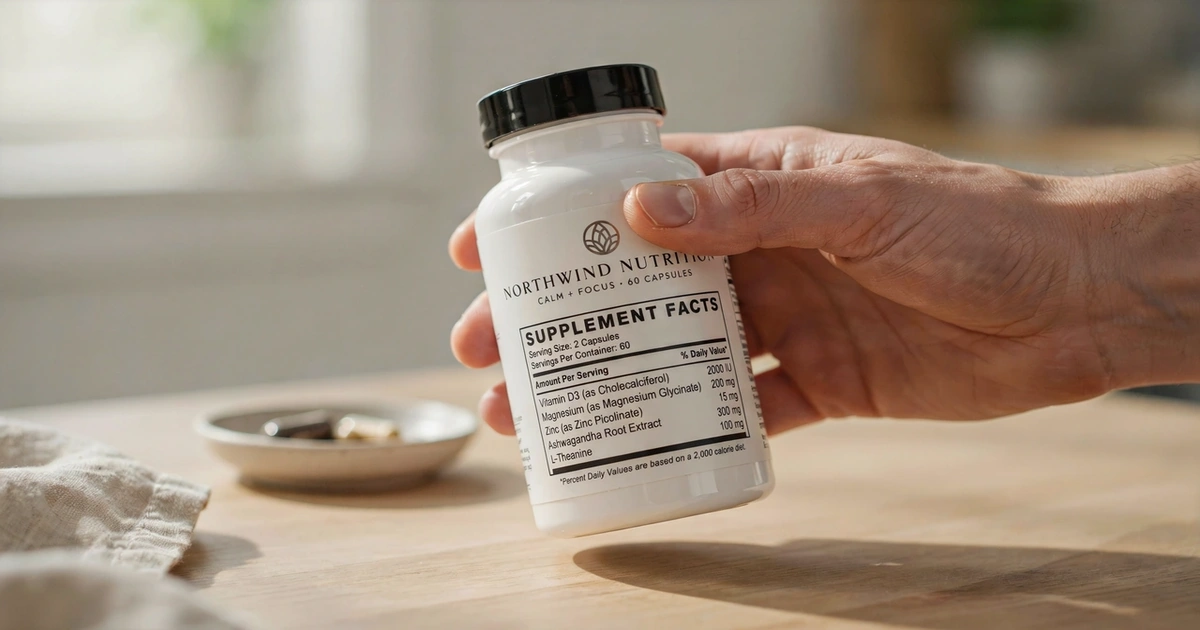

A supplement label is trustworthy when every active ingredient has an individually listed dose, the product avoids vague “proprietary blends,” and it carries a third-party testing seal like USP or NSF Certified for Sport. If a label is missing any of these three things, treat it as a red flag before you buy.
- 21% of supplement labels use proprietary blends, which legally hide individual ingredient doses from consumers.
- Under the DSHEA framework (1994), the FDA does not review or approve supplements before they reach store shelves.
- ConsumerLab has found that roughly 1 in 4 supplements tested have some labeling or contamination issue.
- Magnesium stearate is used at under 1% of total formula weight and is not supported by human evidence as harmful at that level.
- The EU banned titanium dioxide as a food additive in 2022 over genotoxicity concerns; the FDA has issued no equivalent ban as of 2026.
Key Takeaways
- A supplement label has three core parts: the Supplement Facts panel, the “other ingredients” list, and any proprietary blend — each tells you something different about quality.
- Under DSHEA, supplement makers don’t have to prove a product works before it hits store shelves, unlike prescription drugs.
- Proprietary blends can legally hide how much of each ingredient you’re actually getting, making it impossible to compare doses to clinical research.
- People on medications, pregnant or breastfeeding women, and those with chronic health conditions face the highest risk from poorly disclosed ingredients or interactions.
- The fastest way to spot a low-quality supplement is checking for a proprietary blend, a third-party testing seal, and a complete ingredient list with exact doses.
What’s Actually on a Supplement Label?
A supplement label is made up of three main parts: the Supplement Facts panel, the “other ingredients” list, and — on some products — a proprietary blend. Understanding each one is the first step to reading any label correctly.
The Supplement Facts panel is the most important section. It lists each active ingredient along with its exact amount per serving, usually in milligrams (mg), micrograms (mcg), or international units (IU). This panel also shows the % Daily Value (%DV), which tells you how much of the recommended daily amount one serving provides, based on nutrient guidelines from the FDA.
Below the active ingredients, most labels include an “other ingredients” list. This covers everything that isn’t a nutrient or active compound — things like capsule material, fillers, binders, coatings, and preservatives. These ingredients aren’t necessarily harmful, but they’re worth checking, especially for people with allergies or sensitivities.
Look for a third-party testing seal — such as USP, NSF Certified for Sport, or Informed-Choice. These aren’t required by law, but they’re independent verification that what’s on the label matches what’s actually in the bottle. [INTERNAL LINK: how to read a supplement label — certifications that carry weight]
Check serving size before comparing price or dose to a competitor. If a label says “2 capsules” per serving but the bottle holds 60 capsules, that’s a 30-day supply, not 60 days.
How the FDA Regulates Supplement Labels
The FDA regulates supplements more like food than medicine, which means manufacturers don’t have to prove a product is safe or effective before it’s sold. This framework comes from the Dietary Supplement Health and Education Act of 1994 (DSHEA). Under DSHEA, the FDA doesn’t review or approve supplements before they hit the market — the responsibility falls on the manufacturer. The FDA typically only steps in after a product is already on shelves, usually in response to safety complaints, mislabeling reports, or contamination findings. [INTERNAL LINK: are natural supplements FDA approved]
Think of it like the difference between a restaurant inspection and a building permit. A new prescription drug needs a permit before construction even starts — years of clinical trials and FDA review before reaching a single patient. A supplement is more like a restaurant: it can open its doors immediately, and inspectors only show up afterward if something goes wrong.
This doesn’t mean supplements are unsafe by default. Many reputable manufacturers follow Good Manufacturing Practices (GMP), a set of FDA-enforced quality standards covering manufacturing, packaging, and testing. Checking for a “cGMP certified” claim — ideally backed by third-party verification — is one practical way to gauge manufacturing quality despite the lack of pre-market approval.
Ingredients to Watch For in 2026
Not every filler or additive on a supplement label is harmful, but a few categories deserve extra scrutiny. Below are the ingredients that come up most often as red flags in independent product analysis.
Proprietary Blends
A proprietary blend lists a combined total dose for several ingredients without breaking down individual amounts. This matters because clinical research is dose-specific — a study showing benefits at 600 mg of an ingredient tells you nothing if a blend only contains 50 mg of it, hidden among four other compounds.
Artificial Colors and Dyes
Dyes like FD&C Red 40, Yellow 5, and Blue 1 are sometimes added to capsules or gummies purely for visual appeal — they serve no nutritional or functional purpose. The FDA permits these color additives in supplements, but the agency has flagged some synthetic dyes for additional safety review in recent years, and several states have introduced restrictions on Red 3 specifically. California’s Proposition 65 also requires warning labels on certain products containing specific synthetic dyes sold in that state.
Excessive Fillers and Binders
Fillers like microcrystalline cellulose, rice flour, or maltodextrin help bind capsules and tablets together, and small amounts are normal and harmless. The concern arises when fillers make up a disproportionate share of a capsule’s total weight relative to the active ingredients — a sign the product may be diluted.
Titanium Dioxide and Other Coloring Agents
Titanium dioxide is commonly used as a whitening or opacity agent in capsule shells and tablet coatings. The European Food Safety Authority concluded in 2021 that titanium dioxide could no longer be considered safe as a food additive due to potential genotoxicity concerns, leading the EU to ban it in food products by 2022. The FDA has not issued a similar ban as of 2026, but the ingredient remains a point of ongoing safety discussion.
Magnesium Stearate
Magnesium stearate is a common lubricant used to keep ingredients from sticking to manufacturing equipment. Despite some online claims linking it to immune suppression, available human evidence doesn’t support meaningful harm at the small amounts used in supplements — typically under 1% of total formula weight.
Carrageenan
Carrageenan is a thickening agent derived from red seaweed, sometimes used in gummies and liquid supplements. Animal studies have raised questions about gut inflammation effects, though human research on typical dietary supplement amounts remains limited. Some people with existing digestive conditions choose to avoid it as a precaution.
| Ingredient | Concern Level | Why It’s Watched |
|---|---|---|
| Proprietary blends | High | Hides individual ingredient doses |
| Artificial dyes (Red 40, Yellow 5) | Moderate | No functional purpose; under regulatory review |
| Excessive fillers/binders | Moderate | May dilute active ingredient concentration |
| Titanium dioxide | Moderate | Banned in EU food products; under discussion in US |
| Magnesium stearate | Low | Generally safe at typical doses |
| Carrageenan | Low–Moderate | Limited human research; some GI sensitivity reports |
What This Means for You as a Buyer
Knowing what’s on a label only helps if you have a fast, repeatable way to check it. Here’s a simple 3-step method you can use on any supplement bottle before you buy.
Scan the Supplement Facts Panel First
Check whether every active ingredient has an individual dose listed in mg, mcg, or IU. If you see a blend name (like “Recovery Complex”) with one combined weight instead of individual amounts, that’s your first red flag.
Compare Doses to Clinical Research
For any ingredient you specifically want, check the NIH Office of Dietary Supplements fact sheets to see what amount studies actually used. If the label’s dose is significantly lower — or isn’t listed at all — the product likely won’t deliver the benefit it’s marketed for.
Check for Third-Party Certification
Look for a USP, NSF Certified for Sport, or Informed-Choice seal on the packaging. A certification seal doesn’t guarantee perfection, but it significantly lowers the risk of inaccurate dosing or contamination.
This 3-step check takes about 60 seconds per product and works the same way whether you’re standing in a store aisle or shopping online.
Browse Our Transparency-Tested Picks →
* Affiliate link — we may earn a commission
Common Misconceptions About Supplement Labels
Myth: “Natural” Always Means Safe
Many shoppers assume a “natural” or “all-natural” claim means a product carries no risk. In reality, the term “natural” has no standardized legal definition in the supplement industry, so manufacturers can use it almost freely. Plenty of natural compounds — including certain herbs and high-dose vitamins — can interact with medications or cause harm at high doses.
Myth: More Ingredients Means a Better Product
A label listing 25 ingredients can look more impressive than one listing 5, but ingredient count isn’t a quality signal on its own. Often, a longer ingredient list means many compounds are included at token, sub-clinical doses just so the brand can list them on the box.
Myth: If It’s on Store Shelves, the FDA Approved It
The FDA does not review or approve supplements before they’re sold under the DSHEA framework. Being available at a major retailer or pharmacy reflects that store’s purchasing standards, not an FDA safety review.
Summary: Reading Supplement Labels with Confidence
Reading a supplement label well comes down to three checks: are the active ingredients individually dosed, do those doses match clinical research amounts, and is the product third-party tested? If a label can’t answer all three clearly, treat it as a sign of low transparency rather than a dealbreaker on its own.
Because the FDA doesn’t approve supplements before they reach shelves under the DSHEA framework, the responsibility for spotting red flags — proprietary blends, unnecessary dyes, excessive fillers — largely falls on the buyer. A 60-second label check is usually enough to separate a transparent product from a vague one.
Start with the Supplement Facts panel, look for individual doses instead of blend names, and check for a recognized testing seal like USP or NSF.
Frequently Asked Questions
Is it bad if a supplement has a proprietary blend?
What does “other ingredients” mean on a supplement label?
Are supplements FDA approved?
What certifications should I look for on a supplement label?
How do I know if a supplement is high quality?
Why do some supplements use titanium dioxide?
Is magnesium stearate safe in supplements?
- Dietary Supplement Health and Education Act of 1994 (DSHEA) — FDA.gov
- Dietary Supplement Label Database — proprietary blend prevalence data
- European Food Safety Authority, titanium dioxide (E171) safety opinion, 2021
- ConsumerLab.com — independent supplement testing program, 20+ years
- NIH Office of Dietary Supplements fact sheets
Shamim Sarker is the Founder and Lead Health Reviewer at ShamimGuide.com — an independent platform dedicated to evidence-based supplement and health product reviews. With over 8 years of personal research experience in natural health and wellness, he brings a rigorous, science-first approach to every review published on this site.
His areas of focus include men’s health, weight loss, vitamins & supplements, oral health, and skin care. Every product featured on ShamimGuide is evaluated using a strict 4-step research methodology — ingredient analysis, clinical evidence review, user feedback evaluation, and an unbiased final verdict — so readers can make confident, informed decisions without the confusion.
Disclaimer: Content on ShamimGuide is for informational purposes only and does not constitute medical advice. Some articles contain affiliate links — commissions never influence editorial ratings or recommendations.