
Diets & Weight Loss

If you’re in a calorie deficit but not losing weight, the most common cause is that the deficit isn’t as large as you think: small untracked calories add up. Next come water retention hiding fat loss, and a deficit that shrank as you got lighter. Less often, muscle gain, medications, or medical conditions are involved.
- In a 1992 New England Journal of Medicine study, 10 self-described “diet-resistant” adults had normal metabolisms (within 5% of predicted) but under-reported their food intake by an average of 47% and over-reported exercise by 51%.
- Each gram of stored glycogen holds at least 3 grams of water (European Journal of Applied Physiology, 2015), so a carb-heavy day can raise the scale with no change in body fat.
- Resting calorie burn falls by about 10 calories per kilogram lost (Mifflin-St Jeor equation). After a 20-pound loss, a lightly active person’s 500-calorie deficit shrinks to roughly 375.
- Short sleep adds about 100 calories to daily burn but more than 250 calories to daily intake, according to a 2022 Nature Reviews Endocrinology review.
- A true plateau means your weekly average weight and waist have both stayed flat for about 3 weeks. If that happens, trim 100 to 200 calories a day rather than making a large cut.
You’ve been eating less and logging your meals for weeks, yet the scale has barely moved. If you’re asking, “Why am I not losing weight in a calorie deficit?”, you’re in good company. It’s one of the most common frustrations in weight loss, and the answer is rarely that your body is broken.
7 Common Reasons, in the Order You Should Check Them
- You’re eating more than you think.
- Water weight is hiding fat loss.
- Your deficit shrank as you got lighter.
- You’re moving less without noticing.
- You’re building muscle while losing fat.
- Poor sleep and stress are raising your hunger.
- A medication or medical condition is involved.
The first three are the most common culprits, and all seven can be checked at home in a few weeks. Below, you’ll learn how to tell a true plateau from normal day-to-day swings, then work through a step-by-step plan that ends with clear signs it’s time to talk to your doctor.
Are You Actually Stalled? How to Tell a Plateau From Normal Fluctuation
You’re only in a true weight loss plateau if your weekly average weight and your waist circumference have both stayed flat for about three weeks while your eating and activity haven’t changed. A few days with no movement on the scale, or even a small gain, is normal and isn’t a sign that your calorie deficit has stopped working.
Why Do Daily Weigh-Ins Mislead You?
Your body weight moves every day for reasons that have nothing to do with fat.
Moderate Evidence This was one large study, and its participants were maintaining weight loss rather than actively dieting. Still, it shows how normal short-term swings are.
Single mornings can move even more. A salty breakfast, a carb-heavy dinner, how much water you drank, and a rough night’s sleep can all shift the number, according to a September 2026 WeightWatchers article that was scientifically reviewed by a registered dietitian.
What Is the 3-Week Rule for a True Plateau?
That same WeightWatchers guidance defines a real plateau as weight that stays flat for two to three weeks or longer with no change in intake or activity. To check yours accurately:
How to Check for a True Plateau
- Weigh yourself every morning after using the bathroom and before eating or drinking.
- Average each week’s seven readings, and compare one week’s average to the next.
- Measure your waist at your navel once a week, at the same time of day.
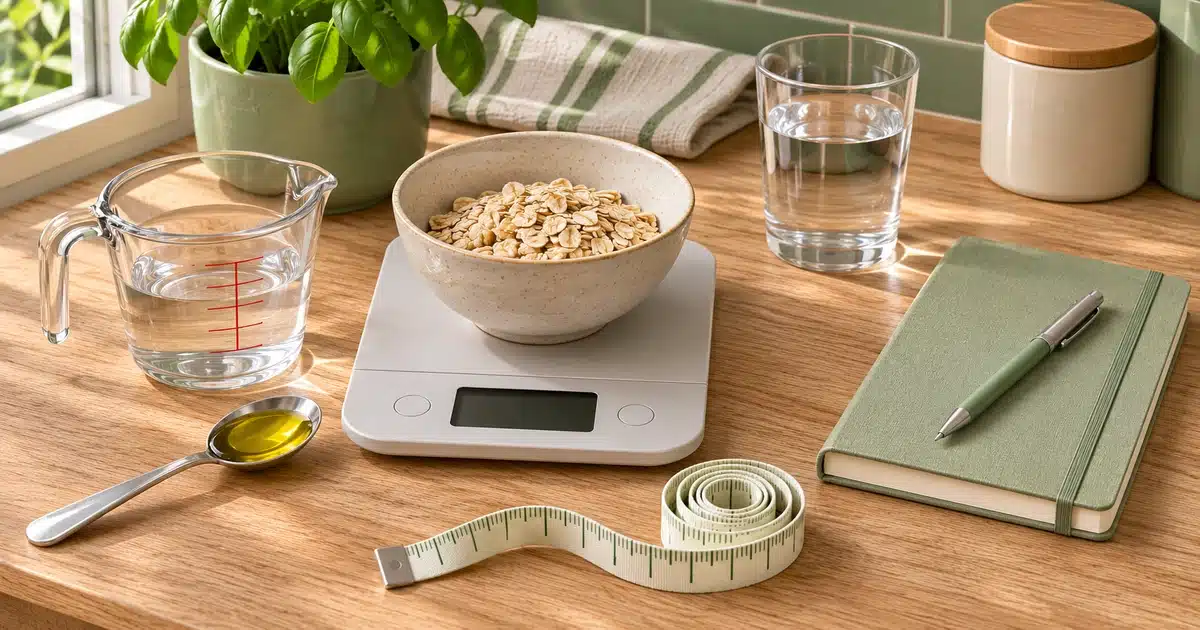
A flexible tape measure makes the waist check easy and costs only a few dollars.
If your weekly average or your waist is still trending down, you’re not stalled. The scale is just noisy.
Illustrative example, not real patient data. The daily readings (gray) bounce around and even rise on Day 12, but the 7-day average (green) drops about 1.6 pounds over two weeks.
Quick Check: Which Reason Fits You?
Use this table to jump to the section that best matches what you’re seeing.
| What You’re Noticing | Most Likely Reason |
|---|---|
| You estimate portions, eat out often, or eat back “earned” workout calories | Reason 1: Hidden calories |
| The scale jumps after a salty or carb-heavy meal, or around your period | Reason 2: Water weight |
| You’ve already lost a lot but still eat the same calorie target as day one | Reason 3: A shrinking deficit |
| Your daily steps are lower than before you started dieting | Reason 4: Less daily movement (NEAT) |
| The scale is flat, but your waist is shrinking and your lifts are going up | Reason 5: Body recomposition |
| You’re sleeping less than usual or snacking when stressed | Reason 6: Sleep and stress |
| You’re gaining without explanation and feel unusually tired or cold | Reason 7: A medical cause |
Reason 1: You’re Eating More Than You Think
The most common reason you’re not losing weight in a calorie deficit is that the deficit is smaller than your app says, because some calories go unlogged or are logged wrong. This doesn’t mean you’re careless. Almost everyone under-counts.
Strong Evidence Under-reporting in general appears consistently across many studies. The exact percentages from the small 1992 study (10 people who described themselves as diet-resistant) are an extreme example rather than a typical figure.
Where Do Hidden Calories Come From?
The usual culprits are small and easy to forget:
- Cooking oil poured straight from the bottle. One tablespoon of olive oil has about 120 calories, according to USDA FoodData Central.
- Coffee creamer, salad dressing, sauces, and spreads.
- Bites while cooking and leftovers from a partner’s or child’s plate.
- Restaurant meals and weekends, when portions are estimated instead of measured.
If you’re judging portions by eye, a basic digital food scale is the quickest way to find out whether your deficit is real. Weigh everything for one week, including drinks and oils, before you change anything else.
Are Food Labels and Fitness Trackers Accurate?
Under FDA labeling rules (21 CFR 101.9), a packaged food can contain up to 20% more calories than its label lists and still comply. Fitness trackers have a similar problem in the other direction. A 2022 review in the European Journal of Applied Physiology found that wearable devices often misjudge how many calories you burn during exercise.
That matters if your app adds “earned” workout calories back to your daily budget. When the burn estimate is too high and you eat those calories back, your deficit quietly shrinks or disappears.
How Much Does Alcohol Count?
Alcohol provides about 7 calories per gram, nearly as much as fat, according to a 2023 review in Obesity Science & Practice. A couple of drinks, especially mixed with juice or soda, can erase a day’s deficit without making you feel full.
Reason 2: Water Weight Is Masking Fat Loss
Yes, water retention can hide real fat loss on the scale for days or even a couple of weeks at a time. Fat comes off slowly, while water can come and go overnight, so a temporary gain in fluid can cancel out the fat you’ve lost.
How Do Carbs, Glycogen, and Salt Affect the Scale?
So a pasta night or a weekend with more carbs than usual can bump the scale up with no change in body fat.
Salty meals work the same way. The WeightWatchers guidance cited earlier lists sodium and water intake among the everyday reasons the number shifts. Food that’s still moving through your digestive tract also adds weight, so constipation can make the scale read higher too.
If you’ve recently started taking creatine, expect a little extra water weight in the first weeks, as the International Society of Sports Nutrition’s 2017 position stand notes. That gain is water stored in muscle, not fat.
Strong Evidence The glycogen-water link is well established, though the exact ratio varies from person to person.
Does Your Menstrual Cycle Change Your Weight?
Moderate Evidence Both studies were small, but they point the same way.
Can a New Workout Routine Cause Water Retention?
Starting or ramping up exercise can also cause temporary water retention while your muscles recover. The registered dietitian who reviewed Health Loft’s 2026 guide lists this as a common reason the scale stalls early on.
Compare weekly averages, not single mornings. If you menstruate, compare your weight at the same point in each cycle.
Reasons 3 & 4: Your Deficit Shrank, and You’re Moving Less
As you lose weight, your body burns fewer calories, so the same eating plan that created a solid deficit at the start can end up close to maintenance. Two things drive this: a smaller body costs less to run, and you tend to move less without noticing.
Why Does a Lighter Body Burn Fewer Calories?
The Mifflin-St Jeor equation, which most online calculators use, estimates that resting calorie burn falls by about 10 calories for every kilogram you lose. Here’s what that looks like in practice:
- Losing 20 pounds (about 9 kg) lowers resting burn by roughly 90 calories a day.
- For a lightly active person, that adds up to about 125 fewer calories burned per day in total (using a standard 1.375 activity multiplier).
- A 500-calorie deficit at the start is now closer to 375, and weight loss slows to match.
Recalculate your maintenance calories, also called your TDEE (total daily energy expenditure), at your current weight, not your starting weight. Any online TDEE calculator that uses the Mifflin-St Jeor equation can do this in about a minute.
Is Metabolic Adaptation Real?
How Metabolic Adaptation Works
Your body can also slow its energy use a bit more than weight loss alone predicts. This is called metabolic adaptation, or adaptive thermogenesis. In a 2020 study in Metabolism, people who showed more adaptation early in a six-week calorie-restricted diet lost less weight.
Moderate Evidence The effect is real but varies widely between people. It slows fat loss; it doesn’t stop it or “break” your metabolism.
How Does a NEAT Drop Shrink Your Deficit?
NEAT can work against you while dieting, too. A 2008 study by Rosenbaum and colleagues found that after people lost at least 10% of their body weight, the energy they spent on movement stayed lower than expected.
Moderate Evidence Both studies were small and done under close supervision, so treat the exact numbers with caution.
Compare your average daily steps now with your average before you started dieting. If they’ve slipped, set a daily step floor near your old average and hold it before cutting any more food.
Reason 5: You’re Building Muscle While Losing Fat
If you’ve started strength training, you may be losing fat and gaining muscle at the same time, which can keep the scale flat even while your body changes. This is called body recomposition, and it’s progress, not a plateau.
Moderate Evidence The 2016 trial was short and limited to young men on an aggressive diet, and the 2026 study looked back at program records rather than randomly assigning people to groups. Expect smaller changes in everyday life.
If your lifts are going up and your waist is shrinking while the scale holds steady, keep going. Measure at the navel, as standard anthropometric guidance describes, and make sure you’re getting enough protein to protect muscle while you lose fat.
Reason 6: Poor Sleep and Chronic Stress
Short sleep and ongoing stress make a calorie deficit harder to keep because they raise your appetite and pull you toward high-calorie foods. They don’t cancel out a true deficit on their own, but they make it easy to drift back to maintenance without realizing it.
Does Short Sleep Raise Hunger More Than Calorie Burn?
Moderate Evidence These findings come mostly from short, controlled lab studies, so long-term effects in daily life may be smaller or larger.
If your nights are short or restless, start with our guide to what sleep hygiene is and how to improve it.
Can Stress Drive Emotional Eating?
Cortisol, your main stress hormone, helps regulate appetite and metabolism, as the Cleveland Clinic explains. A 2024 study of 132 women with obesity in Nutrients linked higher stress to emotional eating and to eating in response to outside cues, like the sight or smell of food.
Preliminary Evidence This was a single cross-sectional study, so it shows an association, not proof that stress causes weight gain.
If stress wakes you up at night, our article on why you wake up at 3 a.m. covers the cortisol connection in more detail.
Reason 7: Medications, Medical Conditions, and GLP-1 Plateaus
If you’ve ruled out tracking errors, water weight, and a shrinking deficit, a medication or health condition may be making weight loss harder. This is less common than the first six reasons, but it’s the one that needs a doctor’s help to sort out.
Which Medical Conditions Are Worth Ruling Out?
The National Institute of Diabetes and Digestive and Kidney Diseases (NIDDK) lists several endocrine diseases that can lead to weight gain, including polycystic ovary syndrome (PCOS), Cushing’s syndrome, and hypothyroidism.
Thyroid-related weight gain is usually smaller than people expect. According to the American Thyroid Association, most of the extra weight in hypothyroidism comes from salt and water, and about 5 to 10 pounds is typically attributable to the thyroid, depending on how severe it is.
Strong Evidence These links are recognized by major health bodies.
Can Perimenopause and Menopause Slow Weight Loss?
These changes don’t erase a calorie deficit, but less muscle means a lower calorie burn. Strength training and enough protein become even more useful at this stage. If hot flashes, poor sleep, or irregular periods come with your stall, mention them to your doctor.
Moderate Evidence SWAN is a large, long-running study, but it tracks changes over time rather than testing a treatment.
Which Medications Can Stall Weight Loss?
Per the same NIDDK page, medicines that may contribute to weight gain include:
- Some medicines for epilepsy, depression, or psychotic disorders
- Corticosteroids (steroids)
- Insulin and sulfonylureas used for diabetes
- Some blood pressure medicines, such as beta-blockers
- Some antihistamines
Never stop or change a prescription on your own. If you suspect a medicine is affecting your weight, ask your doctor whether an alternative might work for you.
Why Am I Stalling on Wegovy, Ozempic, or Zepbound?
A stall doesn’t automatically mean the medicine has stopped working. Your prescriber can review your dose and the other six reasons above with you.
Strong Evidence Both are large, randomized, placebo-controlled trials.
See a doctor promptly if you’re gaining weight without explanation or notice extreme tiredness, feeling cold all the time, thinning hair, missed or irregular periods, or unusual thirst and frequent urination.
Seek care immediately for sudden rapid weight gain, swelling in your legs or belly, shortness of breath, or chest pain.
How to Break a Calorie Deficit Plateau: A Step-by-Step Plan
To break a calorie deficit plateau, check the simple causes first and change one thing at a time before you cut calories further. Work through these steps in order:
Track Honestly for 7 Days
Weigh food in grams, including oils, sauces, and drinks.
Read the Right Numbers
Compare your weekly average weight and your waist measurement, not single weigh-ins.
Recalculate Maintenance at Your Current Weight
Your needs are lower than when you started.
Protect Your Movement, Muscle, and Sleep
Hold your daily step floor, eat enough protein, and strength train on at least two days a week, as the CDC’s physical activity guidelines for adults recommend. Fix sleep and stress where you can.
Wait Two to Three Weeks
Then check your trend again.
Still Flat? Make a Small Cut
Trim about 100 to 200 calories a day, a small enough change that you can tell whether it worked within a few weeks, and keep everything else the same for another two weeks.
Still Stuck After That?
See your doctor or a registered dietitian.
Work down the chart one step at a time, and don’t skip ahead to cutting calories.
Why Does Slashing Calories Backfire?
Cutting hard when you stall usually makes things worse. A 2021 review in the Journal of Obesity & Metabolic Syndrome points to a moderate deficit of about 500 to 750 calories below your daily needs as a sustainable range for most people. Going much lower raises hunger and fatigue, which tends to lead to overeating. In the classic Minnesota Starvation Experiment, healthy young men on a semi-starvation diet of about 1,570 calories a day became preoccupied with food, as the American Psychological Association describes.
Preliminary Evidence This was a single small trial in men only, so it’s an option to discuss with a dietitian rather than a proven fix.
Stop cutting and talk to a doctor if you notice dizziness, constant thoughts about food, cycles of restricting and bingeing, or missed periods. These can be signs you’re eating too little. If food and weight are starting to feel out of control, the National Alliance for Eating Disorders offers free support.
Which Tools Make Troubleshooting Easier?
| Tool | Problem It Solves | Accuracy Note |
|---|---|---|
| Digital food scale | Shows whether your deficit is real | Most accurate when you weigh in grams |
| Flexible tape measure | Tracks fat loss the scale can hide | Measure the same spot at the same time of day |
| Smart scale | Logs daily weight for weekly averages | Body fat percentage is an estimate, so watch the trend rather than the exact number |
| Calorie-tracking app with trend weight | Smooths out daily scale noise and logs intake | Only as accurate as what you log |
The Bottom Line
If you’re wondering, “Why am I not losing weight in a calorie deficit?”, the answer is usually fixable and rarely means your body is broken. Most stalls come from an intake that’s higher than you think, water hiding fat loss, or a deficit that shrank as you got lighter.
Key Takeaways
- Judge progress by your weekly average weight and waist over about three weeks, not by single mornings.
- Weigh your food for a week before changing anything else. Hidden calories are the most common cause of a stall.
- Recalculate your maintenance calories at your current weight, and keep your daily steps from slipping.
- A flat scale while your lifts climb and your waist shrinks is body recomposition, which is progress.
- If you’re still stuck after a small calorie trim, check with a doctor for medical or medication-related causes.
Start with the cheapest, most useful fix. A basic digital food scale and a flexible tape measure will answer most “Is my deficit real?” questions within two weeks. Then recalculate your maintenance calories using your current weight.
Talk to your doctor before making big changes to your diet, especially if you take prescription medicines, have a health condition, or notice any of the warning signs listed above. A registered dietitian can also review your logs and help you build a plan that fits your life.
Medical Disclaimer
Frequently Asked Questions
How long does it take to lose weight in a calorie deficit?
Why am I not losing weight eating 1,500 calories a day?
Can you gain weight in a calorie deficit?
Is my metabolism broken if I’m not losing weight?
Is starvation mode real?
Should I eat less or more if I’ve stopped losing weight?
Why am I not losing weight on Ozempic or Wegovy?
Can menopause stop weight loss in a calorie deficit?
Why does the scale go up after I start working out?
References
The role of insufficient sleep and circadian misalignment in obesity
Underreporting of energy intake in weight loss maintainers
Role of nonexercise activity thermogenesis in resistance to fat gain in humans
Discrepancy between self-reported and actual caloric intake and exercise in obese subjects
References are listed from most recent to oldest.
Shamim Sarker is the Founder and Lead Health Reviewer at ShamimGuide.com — an independent platform dedicated to evidence-based supplement and health product reviews. With over 8 years of personal research experience in natural health and wellness, he brings a rigorous, science-first approach to every review published on this site.
His areas of focus include men’s health, weight loss, vitamins & supplements, oral health, and skin care. Every product featured on ShamimGuide is evaluated using a strict 4-step research methodology — ingredient analysis, clinical evidence review, user feedback evaluation, and an unbiased final verdict — so readers can make confident, informed decisions without the confusion.
Disclaimer: Content on ShamimGuide is for informational purposes only and does not constitute medical advice. Some articles contain affiliate links — commissions never influence editorial ratings or recommendations.