
This article is for informational purposes only and does not constitute medical advice. Always consult a qualified healthcare professional before making any health decisions or starting any supplement.
This post contains affiliate links. We may earn a commission at no extra cost to you. Commissions never influence our content or recommendations.
Diets & Weight Loss

Partly. The new food pyramid shares keto’s focus on protein, whole foods, and cutting added sugar and refined carbs. But the 2025–2030 Dietary Guidelines still recommend fruit, whole grains, and milk, and cap saturated fat at 10% of daily calories. They never mention keto. They only say lower-carb diets may help some people with chronic disease.
- The words “keto” and “ketogenic” don’t appear anywhere in the 2025–2030 Dietary Guidelines. Their only low-carb statement (p. 9) says lower-carb diets may help some people with chronic disease, under a clinician’s guidance.
- Keto typically limits carbs to 20 to 50 grams a day. By our estimate, the pyramid’s daily serving goals add up to about 80 to 185 grams of total carbs on a 2,000-calorie pattern.
- Saturated fat is still capped at 10% of calories, or about 22 grams on a 2,000-calorie day. Two tablespoons of butter plus 2 ounces of cheddar supply roughly 26 grams on their own.
- The new protein goal of 1.2 to 1.6 grams per kilogram of body weight is 50% to 100% higher than the previous minimum, according to Harvard’s Nutrition Source.
- A 2021 BMJ meta-analysis found higher six-month type 2 diabetes remission rates on low-carb diets, though several benefits weakened by 12 months. Keto-level carb restriction is generally contraindicated with SGLT2 inhibitors.
When the federal government flipped the food pyramid upside down in January 2026, parts of the keto world treated it as a win. One UK keto meal company went as far as calling 2026 the year of keto validation. Steak, butter, and whole milk now sit in the widest part of the graphic, and bread got pushed to the tip. So does the new food pyramid support keto, or does it just look that way?
We reviewed the full Dietary Guidelines for Americans, 2025–2030 and the USDA’s official fact sheet. Below, you’ll see what the guidelines actually say about low-carb eating, where they line up with keto, and where the numbers clash. We’ll also cover what the research shows and who should talk to a doctor before cutting carbs hard.
What Is the New Food Pyramid?
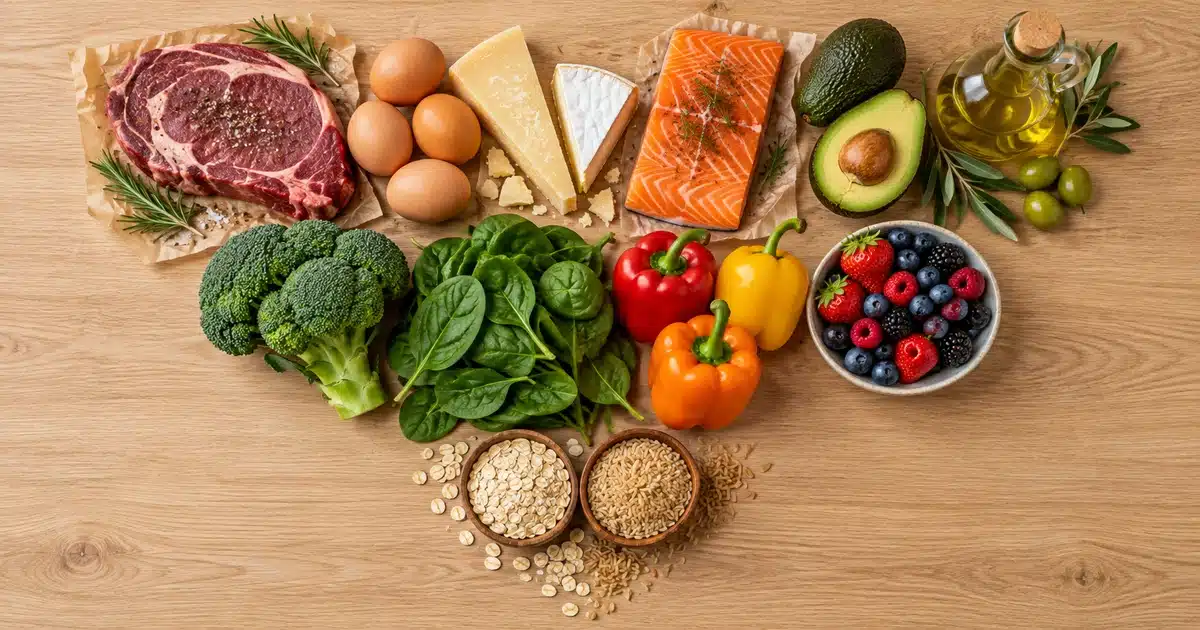
The new food pyramid is the upside-down graphic released with the Dietary Guidelines for Americans, 2025–2030 in January 2026. It puts protein, full-fat dairy, healthy fats, vegetables, and fruits in the wide top section and whole grains in the narrow tip, all under one message: eat real food.
The guidelines come from the U.S. Department of Agriculture (USDA) and the Department of Health and Human Services (HHS), led by Secretaries Brooke Rollins and Robert F. Kennedy Jr., and are published at realfood.gov. They shape school lunches, military meals, and other federal food programs, so the change reaches well beyond your own kitchen.
How Does It Differ From MyPlate and the 1992 Pyramid?
Three shifts stand out:
- Grains moved from the base to the tip. The daily goal is now 2 to 4 servings of whole grains, and refined grains like white bread and crackers should be cut sharply.
- Protein got a bigger target. The new goal of 1.2 to 1.6 grams per kilogram of body weight is 50% to 100% higher than the previous minimum, according to Harvard’s Nutrition Source.
- “Highly processed foods” are named directly. This is the first edition to call out that whole category, not just added sugar and sodium.
If you want to see what that protein range means for your body weight, our guide on how much protein you actually need per day walks through the math.
What Are the Daily Serving Goals?
Here’s what the guidelines recommend for a 2,000-calorie day. These are the numbers we’ll compare against keto throughout this article.
| Food Group or Nutrient | Daily Goal | Key Detail |
|---|---|---|
| Protein | 1.2–1.6 g per kg of body weight | Animal and plant sources, including red meat, eggs, seafood, beans, and nuts |
| Dairy | 3 servings | Full-fat with no added sugars |
| Vegetables | 3 servings | All types, including starchy vegetables |
| Fruits | 2 servings | Whole fruit preferred; juice limited or diluted |
| Whole grains | 2–4 servings | Fiber-rich; refined grains sharply reduced |
| Saturated fat | No more than 10% of calories | Same cap as earlier editions |
| Added sugars | None recommended | No more than 10 g in any one meal |
What Is a Ketogenic Diet?
A ketogenic (keto) diet is a very low-carb, high-fat eating plan designed to push your body into nutritional ketosis. In that state, your body burns fat and makes ketones for fuel instead of relying mainly on glucose. According to the NIH’s StatPearls reference, keto diets typically limit carbohydrates to 20 to 50 grams a day. If you want the basics first, our explainer on how metabolism affects weight loss covers how your body chooses its fuel.
That’s a tight budget. Harvard’s Nutrition Source points out that 50 grams is less than you’d get from a medium plain bagel. According to the same review, typical keto plans get about 70% to 80% of calories from fat, 10% to 20% from protein, and only 5% to 10% from carbs.
typical daily carb limit on a keto diet (StatPearls, NIH)
Most keto followers track net carbs: total carbs minus fiber, and sometimes minus some or all sugar alcohols, depending on the type. Our guide on how net carbs are calculated explains the math with label examples, and our keto diet guide for beginners covers the basics of getting started.
Is Low-Carb the Same as Keto?
Every keto diet is low-carb, but most low-carb diets aren’t keto. The Obesity Medicine Association defines a low-carb diet as fewer than 130 grams of carbs a day, or under 26% of calories. Keto sits at the far end of that range.
| Eating Pattern | Carbs per Day | Share of Calories |
|---|---|---|
| Low-carb | Under 130 g | Under 26% |
| Very low-carb / ketogenic | About 20–50 g | Under 10% |
As you’ll see next, the new guidelines talk about “lower carbohydrate” diets. They never mention ketosis.
What Do the 2025–2030 Guidelines Actually Say About Low-Carb Eating?
The 2025–2030 Dietary Guidelines include exactly one statement on low-carb eating, and it’s narrow. In a short section titled “Individuals with Chronic Disease,” the guidelines say some people:
“may experience improved health outcomes when following a lower carbohydrate diet.” — Dietary Guidelines for Americans, 2025–2030, p. 9
The next sentence tells readers to work with their health care professional to choose a diet that fits their condition. The USDA fact sheet lists this as one of the edition’s key changes and calls it a science-based recommendation.
Three details narrow its scope:
- It applies to “certain chronic diseases.” The document doesn’t name which ones or set a carb number.
- It says “lower carbohydrate,” not “ketogenic.” As the table above showed, lower-carb covers a wide range, and keto is only the extreme end.
- It’s paired with medical supervision. The guidance is framed as something to do with your doctor, not as general advice for everyone.
Did the USDA Endorse Keto?
No. We searched the full guidelines document, and the words “keto” and “ketogenic” don’t appear anywhere in it. The document also contains no macronutrient percentages for carbs, fat, or protein.
That matters because at least one keto product seller has described the guidelines as setting out three equal macronutrient models, including a ketogenic one, along with a five-tier food hierarchy. We couldn’t find either in the official guidelines.
The accurate version is simpler. The guidelines acknowledge that lower-carb eating may help some people with chronic disease, under a clinician’s guidance. That’s a real change from past editions, but it isn’t an endorsement of keto for the general public.
A 2026 review in Nutrients concluded that current research supports lower-carb diets as a therapeutic option for certain people with chronic disease, particularly type 2 diabetes, when used under clinical guidance. The same review noted that benefits aren’t consistent across populations or always sustained over time.
One more piece of context: the scientific foundation for this edition was itself debated. Harvard’s Nutrition Source reports that the independent advisory committee’s report was set aside and replaced by a supplemental scientific analysis, and it raises concerns about the transparency of that change.
HHS and USDA, in their official fact sheet, describe the new recommendations as science-based. Either way, the actual wording on carbs is the part that affects your plate.
Where Do the New Pyramid and Keto Agree?
The new food pyramid and keto agree on the basics of food quality: eat real food, cut added sugar and refined carbs, and build meals around protein. That overlap explains why keto fans felt the new graphic spoke their language. Even a keto-focused registered dietitian at Keto-Mojo called the pyramid a welcome step forward for its emphasis on minimally processed foods.
Here’s where the two line up, based on the guidelines’ own text:
If you already eat keto built around eggs, fish, leafy greens, and avocado, much of your plate already fits the new pyramid. The disagreement starts with the foods keto leaves out, which the diagram below maps out.
- Whole grains (2–4 servings)
- All fruits
- Starchy vegetables
- Milk
- Saturated fat ≤10%
- Few sweeteners
- Real, whole foods
- Less added sugar
- Fewer refined carbs
- Protein every meal
- Full-fat dairy
- Leafy greens
- 20–50 g carbs/day
- 70–80% of calories from fat
- Berries as main fruit
- No grains
- Ketosis is the goal
Where the new food pyramid and a typical keto diet overlap, and where they split. Keto ranges from StatPearls and Harvard’s keto diet review.
Where Do They Clash? Carbs, Fruit, Grains, and Milk
The new food pyramid and keto split over carbohydrates. If you eat the pyramid’s recommended daily servings of grains, fruit, vegetables, and dairy, you’ll land well above keto’s typical limit of 20 to 50 grams of carbs a day, even at the low end.
How Many Carbs Does the New Pyramid Add Up To?
The guidelines don’t give a daily carb target, so we estimated one. We took the official serving sizes from the realfood.gov daily servings chart and applied standard carb values from the diabetes exchange lists. Those lists, developed by the American Diabetes Association and the Academy of Nutrition and Dietetics, estimate about 15 grams per serving of starch or fruit, 12 grams per serving of milk, and 5 grams per serving of non-starchy vegetables.
| Food Group | Daily Goal | Serving Size (Guidelines) | Estimated Total Carbs |
|---|---|---|---|
| Whole grains | 2–4 servings | ½ cup cooked oats or rice, or 1 slice bread | ~30–60 g |
| Fruits | 2 servings | 1 cup raw | ~30–60 g |
| Vegetables | 3 servings | 1 cup raw or cooked | ~15–30 g (more with potatoes or corn) |
| Dairy | 3 servings | 1 cup milk, ¾ cup yogurt, or 1 oz cheese | ~3–36 g (cheese is lowest, milk highest) |
| Total | ~80–185 g per day |
Compare that with keto’s typical ceiling of 20 to 50 grams a day. Even the most carb-conscious version of the pyramid’s daily goals lands at roughly 80 grams of total carbs, well over keto’s upper limit. Subtracting fiber brings the low end down, but by our rough estimate it still sits around 60 grams of net carbs.
The guidelines do say to adjust servings to your own needs, but eating keto means dropping below these goals, not just fine-tuning them.
20–50 g
Keto’s typical carb range and the new pyramid’s estimated range don’t overlap. Keto range from StatPearls (NIH); pyramid estimate calculated from the official daily serving chart using diabetes exchange-list carb values.
Which Foods Does the Pyramid Include That Strict Keto Limits?
Beyond the totals, specific foods separate the two. A registered dietitian’s comparison for Keto-Mojo lists the main ones: the pyramid includes all fruits, starchy vegetables, lactose-rich milk, and small amounts of whole grains, while keto narrows fruit to berries and drops grains completely.
In the Pyramid
- Fruit: Bananas, apples, grapes, and mango
- Starchy vegetables: Potatoes, corn, and green peas
- Whole grains: Oats, brown rice, quinoa, and whole-wheat bread
- Milk: Part of the 3 daily dairy servings
- Beans and lentils: Listed as both protein and vegetables
Limited on Strict Keto
- A single banana can use up much of the day’s carb budget
- Keto favors leafy greens, broccoli, and cauliflower instead
- Keto excludes grains entirely
- A cup of milk carries about 12 grams of carbs from lactose, so many plans swap it for cheese, cream, or unsweetened fermented dairy
- Most keto plans limit them because of their starch
For a closer look at which vegetables fit a tight carb budget, see our list of low-carb vegetables ranked by net carbs.
The Saturated Fat Problem
The new food pyramid still caps saturated fat at 10% of daily calories, and that’s the hardest rule for a typical keto diet to meet. The guidelines state that saturated fat “should not exceed 10% of total daily calories”, the same limit as earlier editions.
saturated fat cap in the 2025–2030 guidelines (about 22 g on 2,000 calories)
The confusion comes from the graphic. Steak, butter, cheese, and whole milk are drawn prominently, and the text lists butter and beef tallow as cooking options.
Harvard nutrition chair Dr. Frank Hu warned that these mixed messages may lead to higher saturated fat intake, which can raise LDL cholesterol. The guidelines themselves add that more high-quality research is needed on which types of fat best support long-term health, so the debate isn’t settled.
For the bigger picture on how different fats affect your heart, see our explainer on saturated fat and heart health.
How Much Saturated Fat Is in a Typical Keto Day?
On a 2,000-calorie day, the 10% cap works out to about 22 grams of saturated fat. Harvard’s keto diet review estimates that a typical 2,000-calorie keto day includes about 165 grams of total fat. To stay under the cap, only about one gram in every seven of those 165 grams can be saturated.
The fat sources you choose decide whether you stay under the cap. Using per-serving values from Harvard’s analysis of the new guidelines, here’s how two keto-style days compare:
| Butter-and-Cheese Keto | Sat Fat | Olive-Oil-Forward Keto | Sat Fat |
|---|---|---|---|
| 2 tbsp butter | ~14 g | 2 tbsp olive oil | ~4 g |
| 2 oz cheddar cheese | ~12 g | 1 oz cheddar cheese | ~6 g |
| 4 oz sirloin steak | ~5 g | 4 oz sirloin steak | ~5 g |
| Subtotal | ~31 g (over the 22 g cap) | Subtotal | ~15 g (room to spare) ✓ |
The butter-and-cheese day blows past the limit with just three foods, before counting eggs, cream, or bacon. The olive-oil version leaves room for the rest of the day’s meals, especially if you build it around unsaturated fats instead of butter and cheese. That also shifts more of your fat toward sources like fish, nuts, and avocado, which are rich in unsaturated fats.
What Does the Research Say About Keto?
Keto has real research behind it for blood sugar control, but the evidence gets thinner the further you look past the first year. Here’s how the main findings grade out, using our Strong / Moderate / Preliminary evidence tiers.
| Outcome | What Studies Show | Evidence Tier |
|---|---|---|
| Blood sugar in type 2 diabetes | Short-term improvement and possible remission; benefits fade by 12 months in many trials | Moderate |
| Preventing type 2 diabetes | Low-carb patterns named among the best-supported options for high-risk adults | Moderate |
| Weight loss | Slightly more weight loss than low-fat diets in trials lasting 12 months or longer; the average difference is about 1 kg | Moderate |
| Drug-resistant epilepsy | May reduce seizures in children whose epilepsy doesn’t respond to medication; used under specialist care | Moderate (established clinical use) |
| Triglycerides and HDL | Triglycerides drop and HDL rises in pooled trials | Moderate |
| LDL cholesterol | Rises on average, with large differences between people | Moderate (low certainty on size) |
| Long-term heart disease and lifespan | Observational data only; food sources appear to matter | Preliminary |
Can Keto Help With Type 2 Diabetes?
Type 2 diabetes is driven largely by insulin resistance, so cutting carbs lowers the amount of glucose the body has to handle after meals.
A 2021 BMJ meta-analysis of randomized trials found that people with type 2 diabetes who stuck to a low-carb diet for six months reached remission more often than those on mostly low-fat diets. The authors rated the evidence moderate to low certainty, and several benefits weakened by 12 months.
The American Diabetes Association’s 2026 Standards of Care advise clinicians to consider reducing carbohydrate intake for some adults with diabetes to improve blood sugar. The ADA also lists Mediterranean-style and low-carb eating as having evidence for preventing type 2 diabetes. Note that the ADA says “low-carbohydrate,” not specifically keto.
Does Keto Work Better for Weight Loss?
Weight loss is the most common reason people try keto. A meta-analysis of randomized trials in the British Journal of Nutrition found that very low-carb ketogenic diets produced slightly more weight loss than low-fat diets after a year or more, by just under 1 kg on average. That’s a real but modest difference, so the diet you can stick with matters more than the label.
For the science behind that, see our guides on how weight loss actually works and how a calorie deficit drives fat loss.
What About Epilepsy, Keto’s Original Medical Use?
Keto was first developed as a medical therapy for epilepsy, and that’s still its most established clinical role. A Cochrane review found that ketogenic diets may reduce seizures in children with drug-resistant epilepsy, though the certainty of the evidence was low. This is a specialist-supervised therapy, not a do-it-yourself plan.
How Does Keto Affect Cholesterol?
A 2026 meta-analysis of randomized trials in BMC Cardiovascular Disorders found keto lowered triglycerides and raised HDL, but also raised LDL by about 8 mg/dL on average. The authors rated certainty for the LDL finding as low and said long-term heart effects remain unknown.
Averages can hide big swings. In a small controlled feeding trial, a keto diet raised LDL in every one of the healthy young women studied.
Anyone on keto should get a lipid panel before starting and again a few months in.
Is Keto Safe Long Term?
No long-term randomized trials track keto and heart attacks or lifespan. The best available data are observational. A large 2018 cohort study and meta-analysis in The Lancet Public Health linked low-carb diets to higher mortality when carbs were replaced with animal fat and protein, but lower mortality when replaced with plant sources.
Observational studies like this can’t prove cause and effect. Diet is self-reported, and other habits can skew results. Still, the pattern lines up with the saturated fat math above: keto built on plants, fish, and olive oil looks different from keto built on bacon and butter.
Who Should Be Careful With Keto?
Keto isn’t safe to start on your own if you take certain diabetes medications, are pregnant or breastfeeding, or have kidney disease or a history of an eating disorder. The guidelines themselves say anyone with a chronic disease should work with a health care professional before adapting their diet.
Talk to Your Doctor First If You Are…
- On insulin or sulfonylureas. Cutting carbs sharply can drop blood sugar fast. A review in Clinical Diabetes notes that some keto trials cut insulin doses in half and stopped sulfonylureas at the start to prevent low blood sugar. Only your doctor should make those changes.
- Taking an SGLT2 inhibitor. These drugs include empagliflozin (Jardiance), dapagliflozin (Farxiga), and canagliflozin (Invokana). They carry an FDA label warning about ketoacidosis, and the FDA identified reduced food and fluid intake among the possible triggers. NIH’s StatPearls says keto-level carb restriction is generally contraindicated with SGLT2 inhibitors.
- Pregnant or breastfeeding. Very low-carb eating isn’t recommended during pregnancy or breastfeeding.
- Living with kidney problems or a history of eating disorders. The same review lists both as reasons to avoid very low-carb diets.
- Managing high LDL or heart disease. Because keto can raise LDL in some people, get a baseline lipid panel and recheck it with your doctor.
If you have diabetes and want to explore carb reduction safely, our guide to low-carb diets for type 2 diabetes covers questions to bring to your appointment.
See a doctor promptly if you notice: nausea, vomiting, stomach pain, trouble breathing, confusion, or unusual tiredness while eating very low-carb, especially if you take an SGLT2 inhibitor. The FDA lists these as possible signs of ketoacidosis, which can happen even when blood sugar is only mildly to moderately elevated. Also seek care for repeated shakiness, sweating, or dizziness that could signal low blood sugar. Don’t stop or change any medication without talking to your doctor first.
How Can You Eat Low-Carb While Staying Close to the Guidelines?
You can eat low-carb and still respect most of the new guidelines if you build meals around unsaturated fats, fish, non-starchy vegetables, and plenty of fiber. Strict keto, on the other hand, will always fall short of the pyramid’s grain, fruit, and dairy goals. If your doctor has cleared you for a lower-carb plan, these habits keep you closest to both frameworks:
What Does a Low-Carb Day Under the Saturated Fat Cap Look Like?
Here’s one example of a lower-carb day that stays under the 10% saturated fat cap. Values are rounded estimates based on USDA nutrient data.
| Meal | Foods | Est. Total Carbs | Est. Fiber | Est. Sat Fat |
|---|---|---|---|---|
| Breakfast | 2 large eggs cooked in 1 tbsp olive oil, 2 cups raw spinach | ~3 g | ~1 g | ~5 g |
| Lunch | 4 oz salmon over 3 cups raw salad vegetables (romaine, cucumber, red bell pepper), ½ avocado, 1 tbsp olive oil | ~20 g | ~9 g | ~6 g |
| Snack | 1 cup mixed berries | ~16 g | ~5 g | ~0 g |
| Dinner | 4 oz sirloin, 1 cup cooked broccoli, 1 cup cooked cauliflower, 1 tbsp olive oil | ~16 g | ~8 g | ~7 g |
| Total | ~55 g total (~32 g net) | ~23 g | ~18 g (under the 22 g cap) |
Sources for estimates: food values from USDA FoodData Central; saturated fat in olive oil and sirloin cross-checked against Harvard’s Nutrition Source.
Notice where this day lands. It has about 55 grams of total carbs, but roughly 23 grams of that is fiber, which leaves about 32 grams of net carbs. Counted as net carbs, that’s inside keto’s typical 20 to 50 gram range.
It gets there by skipping whole grains and dairy servings entirely and including one fruit serving instead of two. So it meets the pyramid’s saturated fat cap, but not its grain, fruit, and dairy goals. For anyone with a chronic condition, the guidelines say a diet choice like this belongs in a conversation with a health care professional.
Tools That Can Help
If you and your doctor decide a lower-carb or keto plan makes sense, a few simple tools make it easier to do safely. None of them are required, and none of them replace medical supervision.
For side-by-side comparisons, see our guide to the best electrolyte supplements for keto.
The Bottom Line
So, does the new food pyramid support keto? Only partway. The 2025–2030 Dietary Guidelines move toward several ideas keto followers have championed for years. But the pyramid is not a ketogenic diet, and the official text never says it is.
Key Takeaways
- The new pyramid and keto agree on real food, less added sugar, fewer refined carbs, and protein at every meal.
- The pyramid’s daily goals add up to an estimated 80 to 185 grams of total carbs, well above keto’s typical 20 to 50 grams.
- The 10% saturated fat cap still applies, and butter-heavy keto can blow past it quickly.
- The only low-carb statement says lower-carb diets may help some people with chronic disease, under medical guidance. The words “keto” and “ketogenic” don’t appear.
- Keto has moderate evidence for short-term blood sugar control; long-term heart outcomes remain uncertain.
If you want to eat lower-carb, the approach that fits best with both frameworks is built on olive oil, fish, eggs, non-starchy vegetables, avocado, and nuts rather than bacon and butter. Our keto diet guide for beginners is a good next step if you’re weighing whether it’s right for you.
This matters most if you have diabetes, take any blood sugar or blood pressure medication, are pregnant, or have kidney or heart concerns. A registered dietitian can help you tailor the guidelines to your health and food preferences.
Frequently Asked Questions
Is the new food pyramid keto?
Does the new food pyramid say to eat more saturated fat?
Are whole grains still part of the new food pyramid?
Does the new food pyramid support the carnivore diet?
Can you follow keto and the Dietary Guidelines at the same time?
Is keto safe for people with type 2 diabetes?
Who should not try a keto diet?
References
1
USDA & U.S. Department of Health and Human Services
Dietary Guidelines for Americans, 2025–2030
January 2026 · View source ↗
2
StatPearls, NCBI Bookshelf (National Library of Medicine)
“Low-Carbohydrate Diet.”
Updated September 2026 · View source ↗
3
The Nutrition Source, Harvard T.H. Chan School of Public Health
“Dietary Guidelines for Americans 2025-2030: Progress on added sugar, protein hype, saturated fat contradictions.”
January 9, 2026 · View source ↗
4
The Nutrition Source, Harvard T.H. Chan School of Public Health
“Diet Review: Ketogenic Diet for Weight Loss.”
September 5, 2025 · View source ↗
5
BMJ, 372:m4743
Goldenberg, J.Z., et al. “Efficacy and safety of low and very low carbohydrate diets for type 2 diabetes remission: systematic review and meta-analysis of published and unpublished randomized trial data.”
January 2021 · View source ↗
6
BMC Cardiovascular Disorders (PubMed 42056882)
“Ketogenic diet–induced changes in adult lipid metabolism: a comprehensive systematic review and meta-regression of randomized controlled trials.”
April 30, 2026 · View source ↗
7
U.S. Food and Drug Administration
“FDA revises labels of SGLT2 inhibitors for diabetes to include warnings about too much acid in the blood and serious urinary tract infections.”
December 4, 2015 · View source ↗
Shamim Sarker is the Founder and Lead Health Reviewer at ShamimGuide.com — an independent platform dedicated to evidence-based supplement and health product reviews. With over 8 years of personal research experience in natural health and wellness, he brings a rigorous, science-first approach to every review published on this site.
His areas of focus include men’s health, weight loss, vitamins & supplements, oral health, and skin care. Every product featured on ShamimGuide is evaluated using a strict 4-step research methodology — ingredient analysis, clinical evidence review, user feedback evaluation, and an unbiased final verdict — so readers can make confident, informed decisions without the confusion.
Disclaimer: Content on ShamimGuide is for informational purposes only and does not constitute medical advice. Some articles contain affiliate links — commissions never influence editorial ratings or recommendations.